Online Resistivity Analyzer: Applications and Selection Guide for Pure Water Plants
Online Resistivity Analyzer: Applications and Selection Guide for Pure Water Plants
Imagine if your deioniser ran out of capacity during the night at 2am, meaning water was flowing through your process outside its specification for several hours. An online resistivity analysers measure the amount of resistance water has to electricity and helps identify when the water is losing purity. This guide explains what an online resistivity analysers is, where to use one, and how to choose the right one for your water.
What is an Online Resistivity Analyzer?
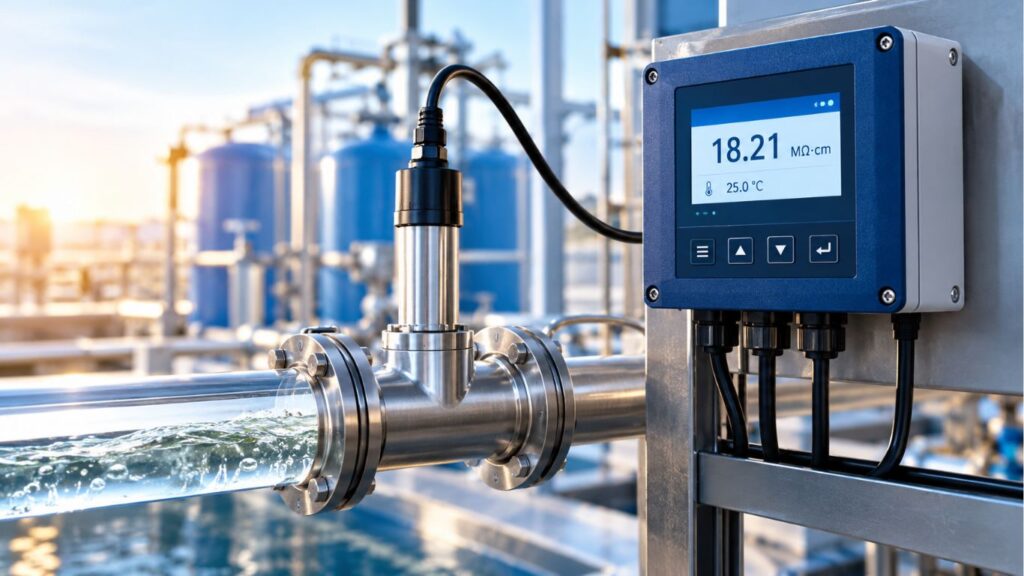
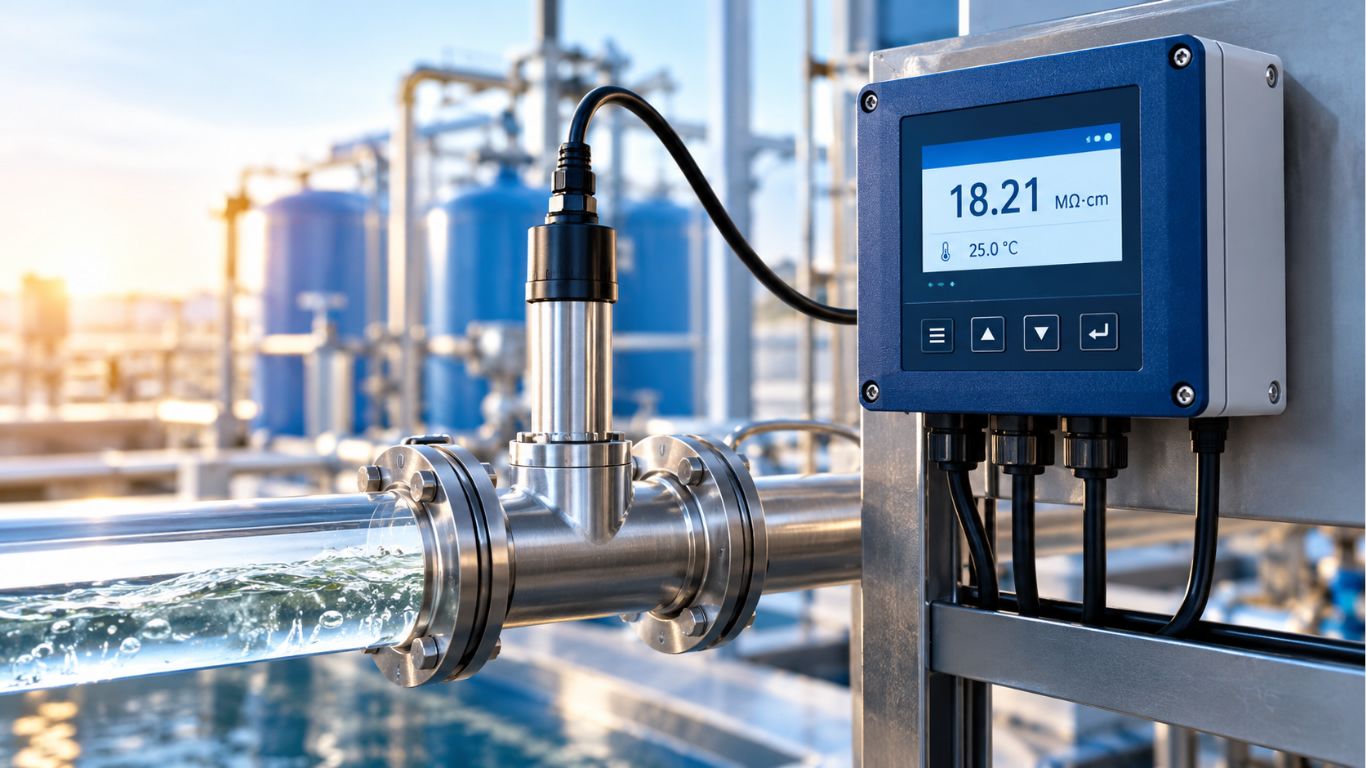
An online resistivity analyzer is an inline measurement device which constantly monitors the electrical resistivity of water. Usually this will be measured in mega ohm centimeters (MΩ·cm). The less ions dissolved in the water, the higher the resistivity will be. Purer water theoretically has a resistivity of around 18.2 MΩ·cm at 25°C.
Typically they consist of three parts, a sensor cell to measure the water, a transmitter to convert and provide temperature compensation, and an output to your system. Temperature compensation is important because resistivity measurements change dramatically with each degree.
Resistivity vs Conductivity: Which Should You Monitor?
The properties measure the same thing. Conductivity is the reciprocal of resistivity, so 18.2 MΩ·cm is equal to 0.055 µS/cm. Purer water like DI / High Purity, will be easier to read using resistivity measurements. However, Raw water, RO feed, or waste water it will be easier using conductivity or TDS measurements.
Where Is an Online Resistivity Analyzer Used?
Any application you want to keep the levels of ions low and know when they are increasing.
Deionized and RO Water Systems
After the mixed bed polish stage you will get a signal showing when the resin is becoming exhausted. A downward trend means it is time to regenerate to maintain quality.
Boiler Feedwater and Power Plant
Having ions in your boiler feed can cause scaling and corrosion, having constant readings will show if there are leaks in the condensers or carryover from the demineralizers.
Pharmaceutical and Laboratory Water
Purified water systems need to show they are maintaining the ionic purity. Constant readings will give a clear history of the water and shows when it begins to drift.
Electronics and Semiconductor Rinse Water
Ions left on the boards / wafers will cause issues. Often an online resistivity analyzer is used on the rinse lines as the main measurement.
How to Choose the Right Online Resistivity Analyzer
Choose the right cell constant, range, temperature compensation and output for your water quality and control system. Here’s how:
- Set your range – If you have an ultrapure system you’ll want to measure up to 18.2MΩ·cm. RO permeate and softened water will be much lower.
- Cell constant – For high purity water you’ll want a low cell constant (approx 0.01-0.1 cm⁻¹). Water with more ions will require a higher cell constant. Using the wrong cell constant will decrease the accuracy.
- Temperature Compensation – Check that it has a built-in temperature sensor and the compensation is suitable for pure water.
- Flow cell – Make sure it has a sealed flow cell to stop air getting into the cell. Air will reduce the resistivity due to CO₂ absorption. The housing should also be suitable for your process.
- Output – Most industrial plants will have a 4-20mA, RS485 Modbus or Relay Alarm output. Check what your controller can take.
- Calibration – Find out how it is verified, how often and what reference will required.
Example: If you have an RO permeate polishing system with a mixed bed deioniser, you will want to ensure the outlet is at least 15MΩ·cm. A low cell constant will be suitable after the polish stage, and an alarm will be set to trigger at 12MΩ·cm to alert operators to regenerate the bed well before the product water drifts out of spec.
Installation Mistakes That Skew Readings
Even the best online resistivity analyzer will give poor readings if the sample isn’t good. Avoid deadlegs, long sample lines and air bubbles. Ensure the flow is within the cell specification, install close to the sample point and compare to lab results once installed.
How can Fluidings Help?
Fluidings Technology based in Navi Mumbai provide online water quality analysers for industrial, STP, ETP and WTP. We offer a wide range including EC/TDS/Salinity/Resistivity sensors, pH/ORP, Dissolved Oxygen, Turbidity and Multi Parameter. This is a great place to start looking at the online resistivity analyzers we offer. If you’re unsure which sensor would be best for your water, our team can discuss with you.
Key Points
- Resistivity is the reciprocal of conductivity and is best for high purity water.
- Most important to consider is the cell constant and range.
- Accuracy depends on sample quality.
- Ensure it is regularly verified against a reference.
Conclusion: Is an Online Resistivity Analyzer Worth It?
If you have ions in your water affecting the quality of your product, lifespan of your equipment or compliance then using an online resistivity analyzer will be beneficial to catch any issues. Know what range your water is in, choose the right cell constant and plan installation and calibration.
Want to take it further? Browse our range or contact our team for a quote/consultation.
FAQ
1. What is an online resistivity analyzer?
An online resistivity analyzer constantly monitors the purity of the water by measuring the resistance. They are used in plants to alert operators to any issues with the resin, membranes or contamination in deionised, RO, boiler and pharma water before the product quality is visibly affected.
2. What is the difference between resistivity and conductivity?
The properties are the same but viewed from the opposite. Conductivity (measured in µS/cm) shows how easily the water conducts electricity. Resistivity (measured in MΩ·cm) shows how much resistance the water has. It is simply the reciprocal. It is easier to read for ultrapure water.
3. What resistivity shows ultrapure water?
Ultrapure water will have a resistivity of around 18.2MΩ·cm at 25°C. This is the theoretical maximum for water with just the hydrogen and hydroxide ions. However, in practice many systems will accept a lower value. You should always set your alarm based on your process requirements.
4. How often should I calibrate my analyzer?
This depends on the purity of your water. Many plants will verify the cell against a reference meter or standard solution every few months. After cleaning, replacing the sensor and unexpected readings they may be done more frequently. Always refer to the instrument manual carefully.
5. Can I use one analyzer to measure resistivity for RO and DI water?
Ideally not, it depends on the cell constant. High purity DI water requires a low cell constant. RO feed / permeate will have more dissolved ions so will require a higher cell constant. Tell the supplier what range your water is in so they can recommend the correct range.