Continuous Oil-in-Water Monitoring in India: UV Fluorescence Explained
Continuous Oil-in-Water Monitoring in India: UV Fluorescence Explained
In India, Continuous Oil in Water detection is increasingly expected within a variety of industries including refineries, power, chemicals and waste water treatment. Small amounts of hydrocarbon can become problematic by both affecting heat exchange and/or causing exceedances. Unfortunately, samples can also frequently fail to show such issues when only sampled once a shift. To overcome these issues, UV fluorescence is widely used for Continuous Oil in Water detection.
What Is Continuous Oil-in-Water Monitoring?
Continuous detection of hydrocarbons in water using an inline instrument that transmits data directly to your PLC or SCADA system without needing to send samples off-site.
As opposed to single data points, you receive continual data. This lets you detect and analyse trends in oil levels, together with analysing if and for how long an issue occurs and whether or not separation was effective. Usually, for new Continuous Oil in Water detection schemes, this functionality is the main point of interest to both plant staff and auditors.
How UV Fluorescence Detects Oil in Water
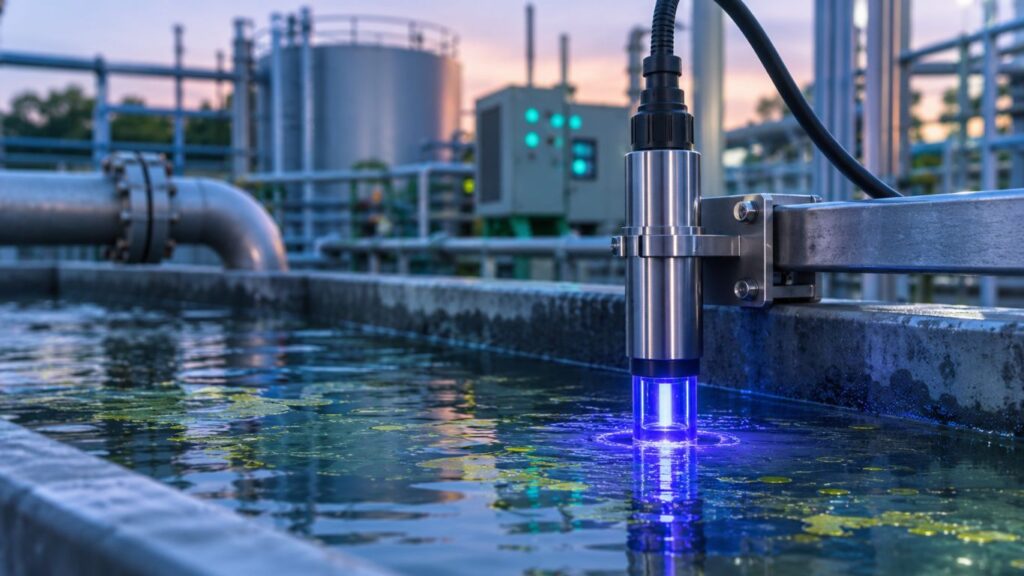
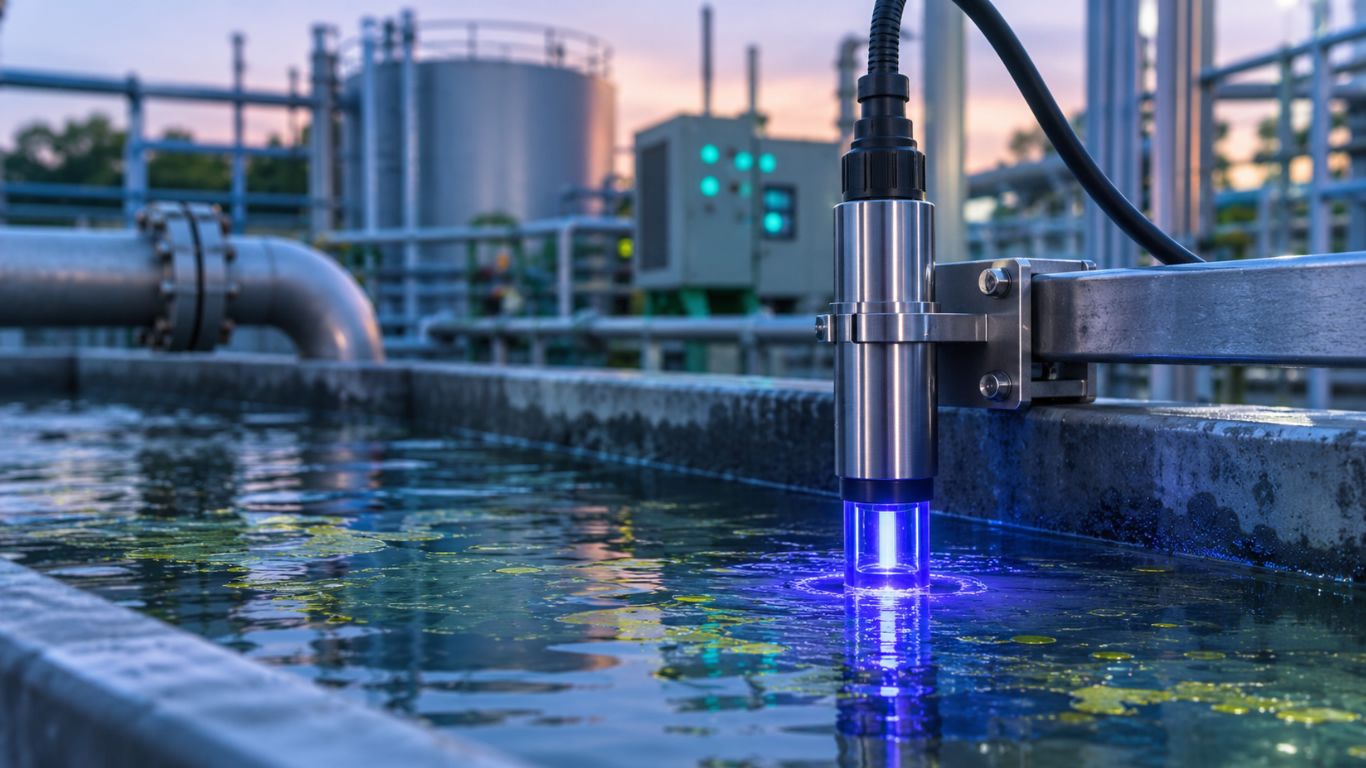
UV light causes hydrocarbons to fluoresce; the wavelength of the fluorescence is longer. The sensor then analyses the fluorescence to establish a level.
In summary:
- UV light is projected into a water sample.
- Aromatic hydrocarbons such as PAHs and monocyclic aromatics then both absorb and re-emit the light, but at a longer wavelength.
- The sensor analyses the re-emitted light. Increased levels of oil result in increased fluorescence.
UV fluorescence is highly suitable for Continuous Oil in Water detection as it detects small levels of hydrocarbon and has no need for chemicals.
Why calibration matters
As mentioned above, UV fluorescence relates to the aromatic component of hydrocarbons. All instruments must therefore be calibrated. Fluidings’ Online Oil in Water Sensor is calibrated against a PTSA solution and has good linearity with most fluorescing organic matter. It has a detection range of 0.15 to 300ppb PTSA.
Why Continuous Oil-in-Water Monitoring in India Matters Now
Wastewater is continually under review. Many sites already submit data via OCEMS and often, consent specifies exact permitted discharge levels (see our guide to OCEMS requirements in India). Timely data from a Continuous Oil in Water scheme is much easier to present to regulators during an inspection than a limited number of samples.
Furthermore, from a financial perspective, membranes, pumps and heat exchangers are affected by oil carry-over. Early detection is thus more economical than subsequent repair or replacement.
Where UV Fluorescence Sensors Are Used
Continuous Oil in Water detection is used in a variety of areas including:
- Refining and petrochemical wastewater
- Oil & gas produced water
- Cooling water discharge from power generation
- Chemical, pharmaceutical and metallurgy process water
- Fuel terminals
- Marine bilge water (typically 15ppm is the discharge standard)
Strengths and Limits of UV Fluorescence
As with all techniques there are pros and cons.
Strengths : high sensitivity, fast response (Fluidings lists T90 under 30 seconds), no consumables and modest maintenance
Disadvantages : As noted above, the results depend on the degree of aromaticity of the oil. Certain non-hydrocarbon fluorescing organic matter such as CDOM/fDOM can also be detected. Additionally, the optical components can become contaminated, influencing results. Remember to treat the instrument as an ongoing tool and cross-check it against your laboratory analysis.
How to Set Up Continuous Oil-in-Water Monitoring in India: 6 Steps
- Determine your oil type. Different oils (refined and crude) fluoresce uniquely. Select a suitable instrument.
- Define the detection range. Include both typical and higher-than-typical values.
- Position the instrument. Place within a well-agitated section of pipework, ideally post-separation or at discharge. Avoid areas containing air bubbles.
- Develop a maintenance programme. Regularly inspect the optical components, particularly if the medium is oily or contains sludge.
- Establish the instrument data format. Fluidings’ Online Oil in Water Sensor offers data in RS485/Modbus RTU format – compatible with most control systems.
- Cross-check with laboratory data. Regularly compare the instrument data with laboratory findings and modify alert thresholds as required.
What to Look for in a Sensor
Consider the detection technology, together with range, speed of detection, construction and calibration frequency. Fluidings’ Online Oil in Water Sensor is rated to IP68, built from 316 stainless steel, POM and quartz glass and has a six month calibration period. Both crude oil and refined oil variants are available. Refer to our online oil in water detection instruments application guide for further information. Should you be unsure which instrument is best suited to your medium, contact the Fluidings team or ask for a quotation.
Final Thoughts on Continuous Oil-in-Water Monitoring in India
UV fluorescence is an excellent Continuous Oil in Water detection technique due to its speed, sensitivity and ease of maintenance. Select an appropriate instrument for your oil type, install it in a suitable, agitated medium and cross-check it with laboratory analysis. In this way, oil ceases to be an unknown variable and becomes quantifiable.
FAQs
1. What is UV fluorescence?
UV fluorescence is where a UV light source causes aromatic hydrocarbons within a water sample to fluoresce. The light is then re-emitted at a longer wavelength. The sensor analyses this and the intensity of the re-emitted light correlates with oil level. Data is thus continuously and instantaneously analysed.
2. How frequently should a UV fluorescence Continuous Oil in Water detection instrument be calibrated?
This varies depending on medium quality and the manufacturer’s recommendations. Fluidings advises a six month calibration/maintenance period for its Online Oil in Water sensor instrument. Where media is dirty or is known to become contaminated, more regular optical inspections may be necessary. Particularly in the initial months, ensure that the optical components are in good condition.
3. Can UV fluorescence detect all oil types?
Whilst UV fluorescence can analyse most oils, it is predominantly influenced by aromaticity. Consequently, refined and many crude oils give strong results. However, highly saturated oils produce a weaker response. Again, select an instrument calibrated for your oil and cross-check with laboratory analysis.
4. Is Continuous Oil in Water detection compulsory in India?
This depends on your industry, geographical area and your site’s consent. Certain consents and OCEMS related guidance specify that online data must be provided. Alternatively, some allow sampling. Check the relevant state pollution control board guidelines and consult your compliance department to ensure you meet requirements prior to purchasing.
5. Where should a UV fluorescence instrument be installed?
Install within an appropriately agitated section of medium. Again, post-separation or at discharge are good locations. Avoid areas containing air bubbles and stagnant media. Also, ensure that access is available for maintenance. Frequently, sites analyse their inlet media.