Why Water Quality Sensor Readings Drift: 7 Causes and Fixes
Why Water Quality Sensor Readings Drift: 7 Causes and Fixes
Typical causes of water quality sensors drifting include; bio-film, aged sensors, temperature and incorrect calibration. This information is aimed at plant operators, EHS officers and maintenance staff that use online water quality monitoring. Sections include: bio-film, calibration, aged sensors, reference junction, temperature, installation and electrical interference.
What Is Water Quality Sensor Readings Drift?
Drift refers to gradual deviation of a sensor’s output from the actual value. Unlike ‘noise’ which is erratic, or ‘failure’ which produces a constant or blank output; drift is the most insidious of the three issues as outputs continue to appear reliable.
| Problem | What you see |
| Drift | Gradual one-way offset |
| Noise | Random jumps around the true value |
| Failure | Flat or no reading |
How to Tell Water Quality Sensor Readings Drift From a Process Change
- Take a manual or lab analysed sample and compare it with the online water quality output at the same time.
- Analyse the output pattern. During periods of stable process behaviour, a gradually sloping line indicates drift.
- If the reference output corresponds with the online output then it was the process that has varied. Conversely, if there is a mismatch then the issue lies with the sensor.
7 Causes of Water Quality Sensor Readings Drift
1. Fouling and Biofilm on the Sensing Surface
Output issue: Deviation in DO, turbidity, chlorophyll and other sensors.
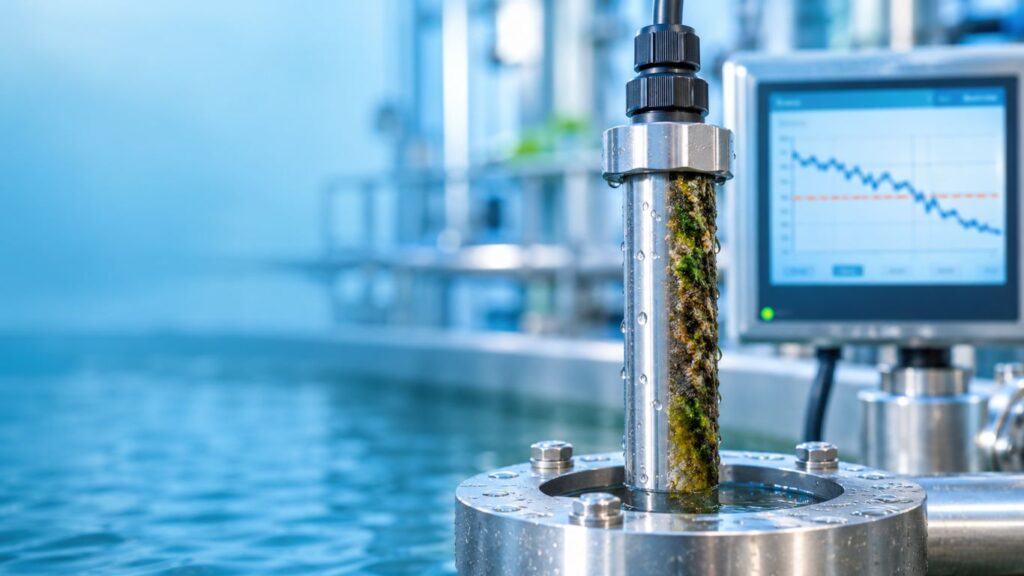
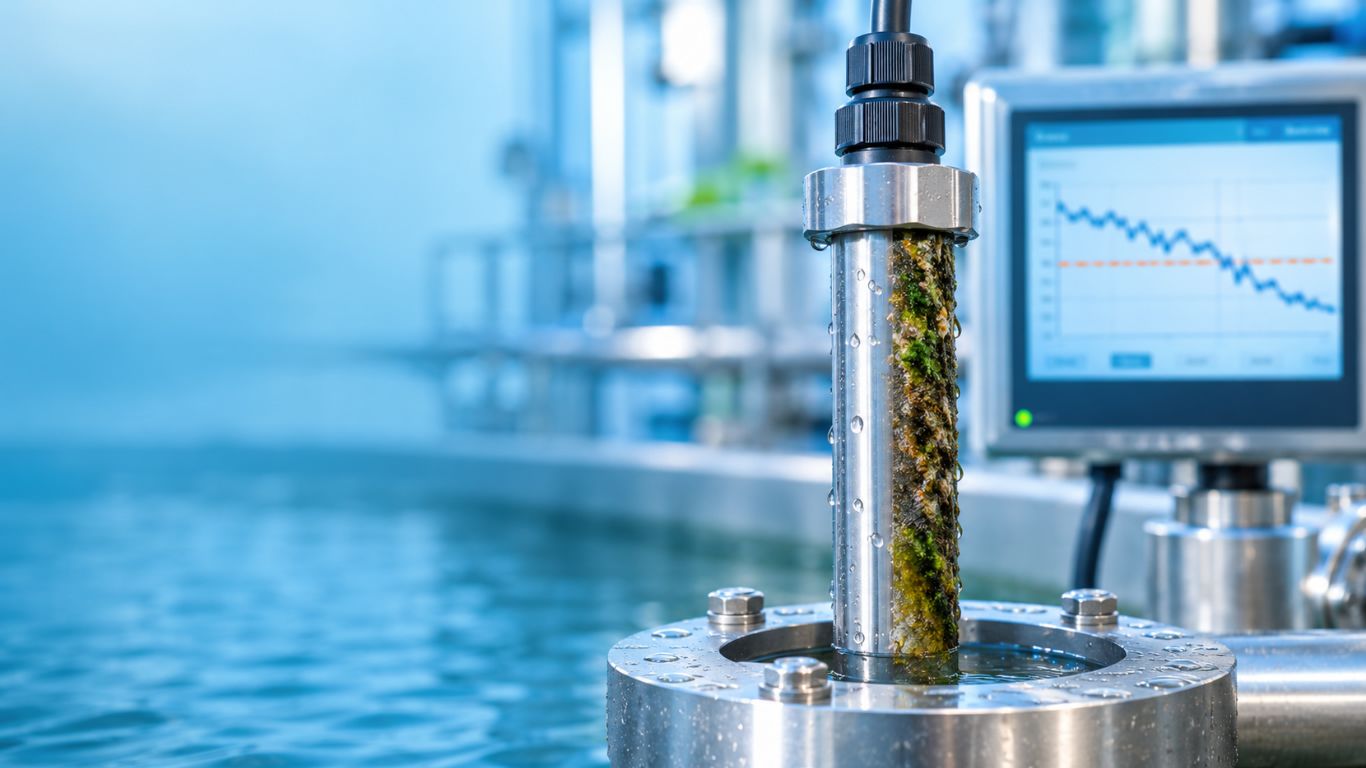
Cause: Bio-film and dirt including algae, oil and scale accumulates on the sensor. This is the most common cause of drift in optical and DO sensors.
Action: Wipe with an appropriate wipe for the sensor. Re-reference the sensor.
Preventative action: Establish a cleaning regime according to the level of dirt in your water.
2. Overdue or Incorrect Calibration
Output issue: Output varies from reference by a constant value.
Cause: All sensors degrade over time. Using old or dirty calibration standards exacerbates this.
Action: Calibrate using new, up-to-date calibration standards.
Preventative action: Calibrate at the recommended frequency detailed in your sensor’s handbook and record this.
3. Ageing Electrodes and Membranes
Output issue: Reduced speed of response and deterioration in the calibration slope for pH/ORP, ammonia and nitrate ion selective sensors.
Cause: Glass and other membranes degrade.
Action: Clean and re-reference. Should the slope continue to be sub-standard, then change the electrode/membrane.
Preventative action: Monitor the calibration slope and schedule electrode/membrane replacement.
4. Reference Electrode Contamination or Clogged Junction
Output issue: pH/ORP output does not stabilise despite re-calibration.
Cause: Process substances contaminate the reference junction. Also, physical matter can block the reference junction.
Action: Clean the reference junction as detailed in your sensor handbook. If the sensor does not then function correctly, change it.
Preventative action: Limit prolonged contact with aggressive substances and store the sensor as directed.
5. Temperature Compensation Errors
Output issue: Outputs fluctuate in line with temperature variations throughout the day. This is particularly evident for conductivity, pH and DO.
Cause: Faulty temperature compensation or incorrect settings are the cause of output variation due to temperature.
Action: Cross-reference the temperature reading with a thermometer and amend the settings where necessary.
Preventative action: Assess temperature during each service visit.
6. Wrong Installation
Output issue: Output fluctuates or deviates and this varies with flow rate and water level.
Cause: Air pockets, inadequate flow, incorrect immersion depth and proximity of the sensor to walls or deposits all impact on output. Optical sensors are particularly affected by these factors.
Action: Re-install the sensor as outlined in your handbook for your particular sensor type.
Preventative action: Assess installation during initial installation and following any servicing work.
7. Electrical Interference and Poor Grounding
Output issue: Unstable output and/or communication failure for digital RS485/Modbus sensors.
Cause: Electrical interference is increased by lengthy cabling, loose connections, proximity to motors and drives and poor earthing.
Action: Examine cables. Employ screened cabling and ensure proper earthing.
Preventative action: Separate signal and power cabling.
Checklist to Fix Water Quality Sensor Readings Drift
- Clean the sensor.
- Verify against a reference sample.
- Recalibrate with fresh standards.
- Check wiring, grounding and installation.
- Replace the consumable part if the offset remains.
Recommended Maintenance by Sensor Type
Whilst both sensor type and water conditions will affect the ideal servicing frequency, always adhere to your handbook guidance. Establish a servicing programme for pH/ORP, conductivity, dissolved oxygen, turbidity, free chlorine, ammonia, nitrate and COD (UV254) sensors. Typically, DO and turbidity sensors require most frequent servicing as they are used in dirty water.
Mistakes That Make Water Quality Sensor Readings Drift Worse
- Using out-of-date buffer standards for calibration
- Wiping with inappropriate cleaning agent
- Failure to cross-reference
When to Repair, Recalibrate or Replace
| Symptom | Action |
| Small offset after a long interval | Clean and recalibrate |
| Poor slope after calibration | Replace electrode or membrane |
| Erratic data or dropouts | Check cable, grounding and installation |
| Physical damage or exhausted life | Replace the sensor |
How Fluidings Can Help
Fluidings offer online water quality monitoring and service provision nationwide in India. Our digital RS485/Modbus sensors minimise cabling and electrical interference issues. We can also advise on the creation of a servicing regime to effectively manage drift.
Book a free sensor health assessment] → /enquiry-now/
Conclusion
Typically, bio-film, incorrect calibration and aged sensors are the main causes of water quality sensor drift. Appropriate cleaning, cross-referencing and timely replacement ensures that your online water quality monitoring continues to provide reliable information. For further advice, please speak to our team.
FAQs
What typically causes drift?
Bio-film, aged sensors and temperature, alongside infrequent calibration, are typical causes. Routine cleaning and cross-referencing will usually allow early identification of issues.
How frequently should I re-calibrate my online pH sensor?
This will vary according to both your water and the sensor type. In addition to adhering to the re-calibration frequency identified in your handbook, re-calibrate more frequently if cross-referencing identifies drift.
Can I resolve drift issues without changing my sensor?
Generally, yes. Most drift can be resolved via cleaning and re-calibration. Sensors should only be changed when the sensing component has reached the end of its life.
When should I change my electrode?
Electrodes should be changed if the calibration slope is continuously sub-standard, if the electrode is greatly slowed in responding to process changes or if output remains unstable following cleaning and re-calibration.
Can temperature affect conductivity output?
Yes, if temperature compensation is incorrectly set or if the temperature sensor is faulty. Initially, cross-reference the temperature reading.